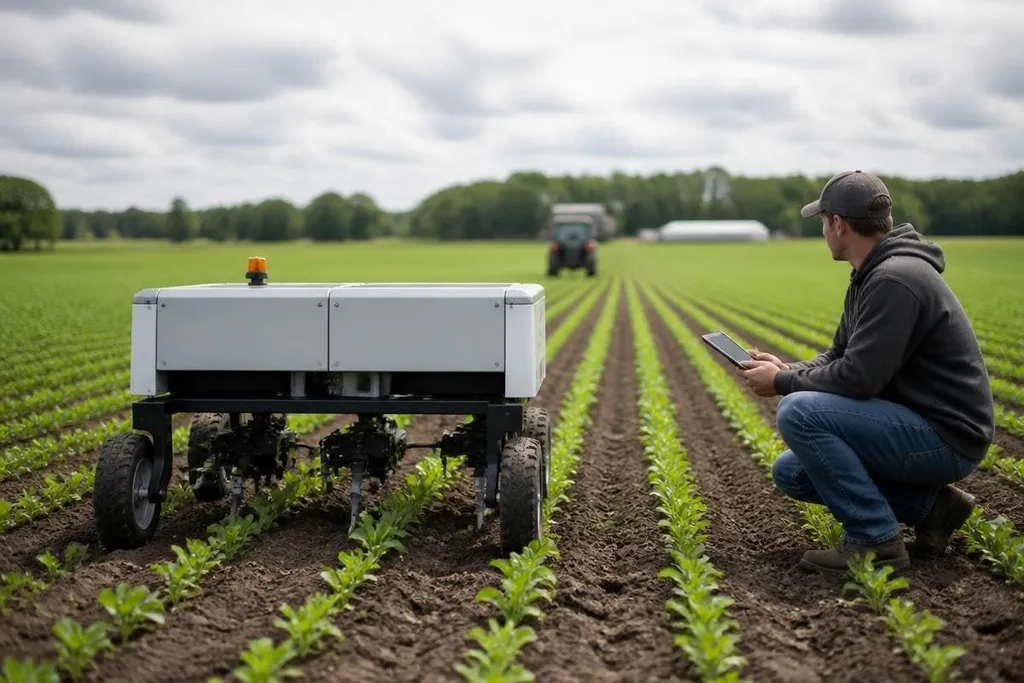
Farm robots can follow crop rows, remove weeds, carry supplies, or collect field data while a person handles planning and repairs. That changes where farm labor goes: away from some repeated work and toward checking machines, crops, and decisions.
For a grower weighing automation, the useful question is not whether a robot looks capable. It is whether the machine can do one job on this farm, across changing weather, soil, crops, and working hours.
- Field work: autonomous tractors and small carriers can move through planned routes.
- Crop care: cameras can help find plants, weeds, and fruit that need attention.
- Farm records: sensors can collect crop and soil data during normal work.
The jobs robots can handle
Farm robots work best when the task repeats and the setting is clear. Row crops give a machine a path to follow, while orchards give it fixed spaces between trees. That lets cameras, GPS, LiDAR, and other sensors help the robot estimate its position and avoid obstacles.
Autonomous tractors can follow mapped routes for tasks such as pulling equipment or moving between work areas. Smaller machines can work close to plants, where a large tractor may damage crops or compact soil. The machine still needs a person to set the route, check the work, and respond when the field changes.
Harvesting is harder. A robot must find ripe produce, place its gripper around it, remove it without damage, and put it into a container. Leaves, shadows, rain, and fruit hidden behind other fruit can all make that task harder than a clean demonstration suggests.
Why farms are testing them
Repeated field work takes time, fuel, and people. A robot can keep working on a planned task while the farm team handles jobs that need judgment, such as crop checks, equipment service, and supply planning.
That does not make automation a fit for every farm. A robot built for straight crop rows may struggle on steep ground or mixed fields. A machine that works well in one crop may need new software, tools, or safety settings for another.
The cost also reaches beyond the robot. A farm may need charging equipment, better field maps, network coverage, spare parts, training, and a person who can check the system each day.
Those added costs make the test site important. For a farmer comparing field robots with factory systems, a report from Robot 24 can name the machine, field, task, and date behind each claim. A robot that works under a roof may face dust, uneven soil, or a weak network outdoors. The next test is what its sensors can see when field conditions change.
Sensors make the difference
A farm robot usually combines several sources of information. Cameras can inspect color and shape. GPS can guide movement across a field. LiDAR measures distance with light, which helps the robot detect trees, posts, people, and equipment.
The control system turns those inputs into actions. It may slow the robot near an obstacle, stop when a person enters its path, or change the route after finding a blocked area. These systems still need testing because dust, mud, glare, tall plants, and poor network signals can affect what the sensors see.
Data collection can matter even when the robot does not perform physical work. A scouting robot may record plant images for later review. That gives the farm a record of crop conditions, but the value depends on how quickly someone can turn those records into a useful field decision.
What still needs a person
A robot can repeat a task. It cannot remove the need for farm knowledge. Someone must decide where the robot works, check whether the crop is ready, manage safety around people and animals, and fix problems after a storm or equipment fault.
The open issue is reliability across a full season. A machine may work well during a dry test week and need more help after rain changes the soil or crops grow beyond the sensor's training data. I’d buy agricultural automation for one measured task before replacing a wider farm process.
A practical buying checklist
Use these checks before choosing a machine:
- Name one task: write down the work, field, crop, and hours the robot must cover.
- Check the route: confirm row spacing, slopes, gates, turning space, and areas with weak signals.
- Price the whole setup: include the robot, tools, charging, software, training, service, and spare parts.
- Set a stop rule: decide when the machine must stop for a person, animal, weather event, or sensor fault.
- Measure the result: record labor hours, crop damage, work completed, and repairs during the test.
A useful farm robot will earn its place through repeatable work that can be measured. The next decision is not whether agricultural robots belong on farms; it is which single task gives this farm enough proof to buy the next machine.